Four moments of the day
Take the order. Dispatch it. Run the route. Get paid.
Not a list of nouns. This is the order things actually happen in, from the phone ringing to the money landing.
01 · Taking the order
Customer, address, can, date. Done.
Four fields while they’re still on the phone. Known customers and known sites fill themselves. The price resolves as you pick the size, so you can quote before you hang up — and the task lands on the board the moment you book it.
- Yard stock checked as you choose — sizes with none free say so
- Overage rate shown at booking, so the customer hears it from you first
- Or let them book it themselves at 11pm — same order, same board
02 · Dispatch
Your whole day on one screen
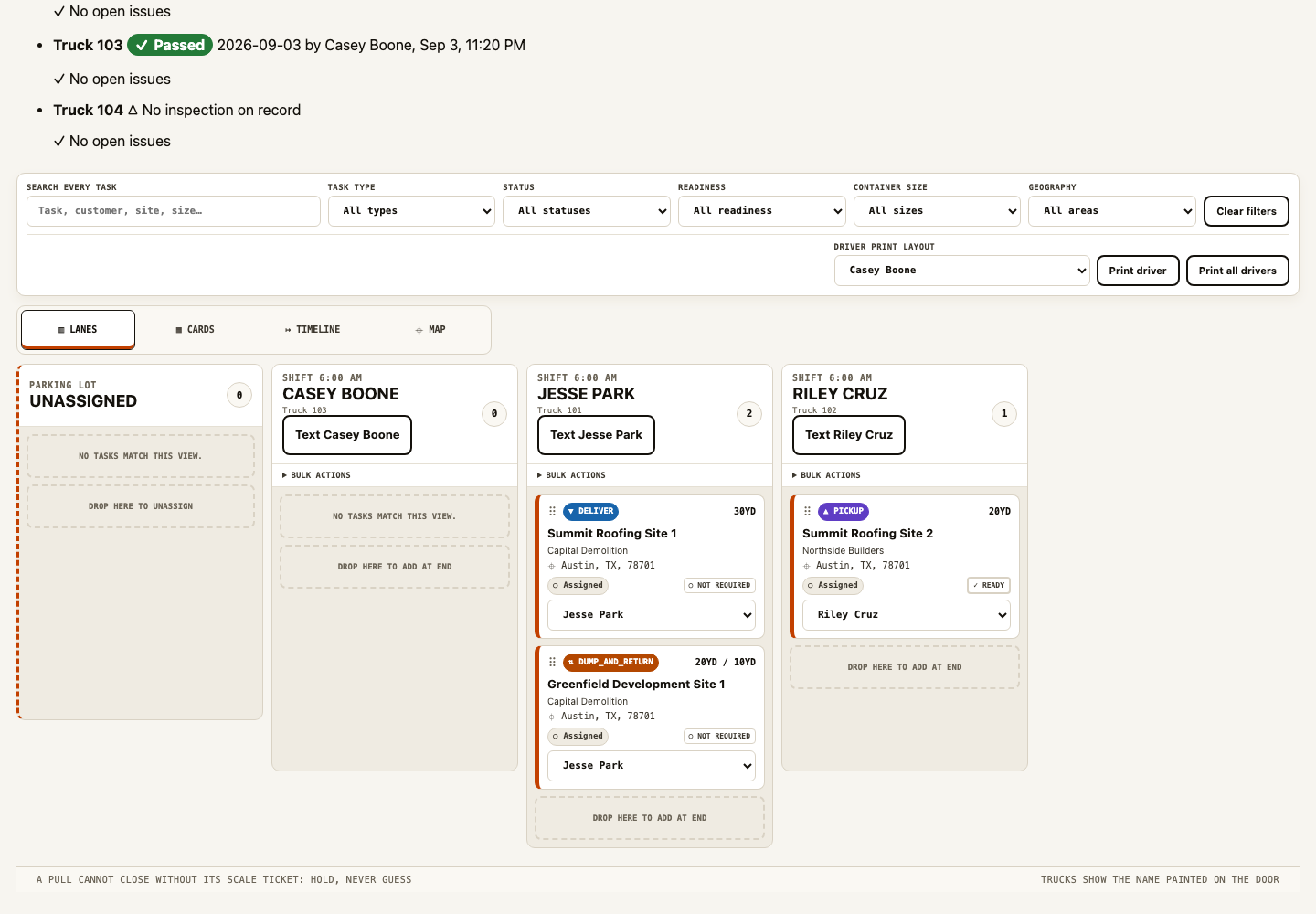
The whiteboard, the wall calendar, the notebook and the map, in one place, at a density you can scan. Drag a job from the unassigned queue onto a driver’s lane and the phone in that truck knows about it.
- 10 to 100 jobs a day without scrolling for the one you want
- A swap is one job with two sides — never two jobs pretending
- Trucks read as the name painted on the door, not an id
- A pull can’t close without its ticket — the ◆ gate holds it
03 · Running the route
Photos, signatures, tickets — captured, kept, synced
Everything a driver collects lands on the phone first and stays there until the office confirms it arrived. The outbox tells them what’s waiting in words. Nothing about finishing a stop depends on a bar of signal.
- Container photos at drop and pull, timestamped where they happened
- Signature on the glass, saved offline like everything else
- Scale ticket photographed at the landfill and attached to the right side of the visit
04 · Getting paid
The overage is on the invoice before dinner
The ticket the driver photographed this morning becomes a charge this afternoon, with the picture attached to the line. When a customer argues the weight, you forward evidence instead of an apology. A pull with no ticket stays held, so a weight is never invented and an overage never slips through unbilled.
- Weight and day overages calculated, shown, then charged — in that order
- Card, bank, or money you already have in the office, recorded honestly
- Customers pay from a link in the email, no account to make
Inside the dispatch board
Actual local product capture with synthetic seed records, September 4, 2026. Open the image to inspect the lanes and controls.
Explore the work, try the numbers
Practical guides, interactive examples and worksheets for your evaluation.
- Roll-off dispatch and recurring routes
Ten to a hundred jobs a day, four drivers, and a customer on hold asking whether anyone can get there this afternoon. One screen has to answer that in the time it takes to look at it.
- Dumpster container tracking and accountability
Where it is, who has it, how long it’s sat, and what it has earned since it left the yard. “Last seen” carries its own freshness, so you know whether to trust it.
- Scale tickets, overage billing and invoice evidence
The page walks the whole loop and shows the sum at each stage, so you can check our maths before you trust it with your money.
- Offline driver app for dumpster haulers
Rural coverage is the normal condition. This page shows a full stop completed with the radio off, then the outbox draining when a bar comes back — and the checklist to prove it on your own phones.
- English and Spanish dumpster operations software
Each driver sets their own language on their own phone. The office doesn’t have to decide, and nobody’s screen moves when they switch.
- Dumpster online booking and customer portal
Your own page, your prices, your sizes. The order lands on the same board as one you took by phone, and a returning customer finds their invoices and evidence in the portal.
- Roll-off job profitability and billing reports
Columns and rows, not gauges. Revenue against disposal, hauling and days out, by customer and by material — the two cuts that change what you quote.
- Smooth Hauling integrations, API and accounting limits
Every event is signed so you can prove it came from us, and kept so you can ask for it again after your endpoint has been down all afternoon.
- Switch from dumpster spreadsheets: migration checklist
Prepare customers, sites and container records for migration. Download operational worksheets and use a small reconciliation before moving the whole operation.
- Dumpster rental software buyer guide
Seven steps to run on any product you’re considering, including this one: in a trial, on real jobs, with a real driver holding the phone.
- Dumpster weight and extra-day overage calculator
Type in the ticket. It gives you the lines you’d put on the invoice, and shows the arithmetic so you can check it against your own.
- Missed dumpster billing calculator
Put in your own assumptions. The answer is arithmetic on what you typed — we have no industry average to sell you, and we’re not going to invent one.
Run one week of real jobs through it
Thirty days free, no card, no sales call. Start with a spreadsheet’s worth of customers and see if the ticket loop holds.